2026 Dynamic Proxies: Rotation Setup & AI Search Workflows

Most teams do not search for dynamic residential proxies because they enjoy technical jargon.
They search because something in the workflow starts breaking.
A keyword ranking looks different in every country. A product page shows another price in another market. An ad campaign needs to be checked from the buyer’s region. A data collection task keeps slowing down because all requests come from the same network pattern. An AI search monitoring workflow needs regional answers, not generic global guesses.
That is usually the moment when “any proxy” stops being enough.
Dynamic residential proxies are built for flexible, real-user-style access across different locations. Instead of locking your workflow to one fixed IP, they rotate through residential IP resources so your tasks can be distributed across markets, sessions and network identities.
For business use, the value is not just “changing IP.”
The real value is controlled GEO visibility.
Explore the solutions directly on the Dynamic Residential Proxies page by InstaIP.
Quick Answer
Dynamic residential proxies are residential proxy IPs that can rotate based on request, time, session rule or business need.
They route traffic through real residential network resources while allowing users to switch IPs dynamically. This makes them useful for SEO monitoring, ad verification, e-commerce research, public data collection, market research, localized testing and AI search visibility tracking.
In simple terms:
- Static residential proxies are better when you need one stable identity.
- Dynamic residential proxies are better when you need flexible access across many locations, sessions or public data workflows.
What Are Dynamic Residential Proxies?
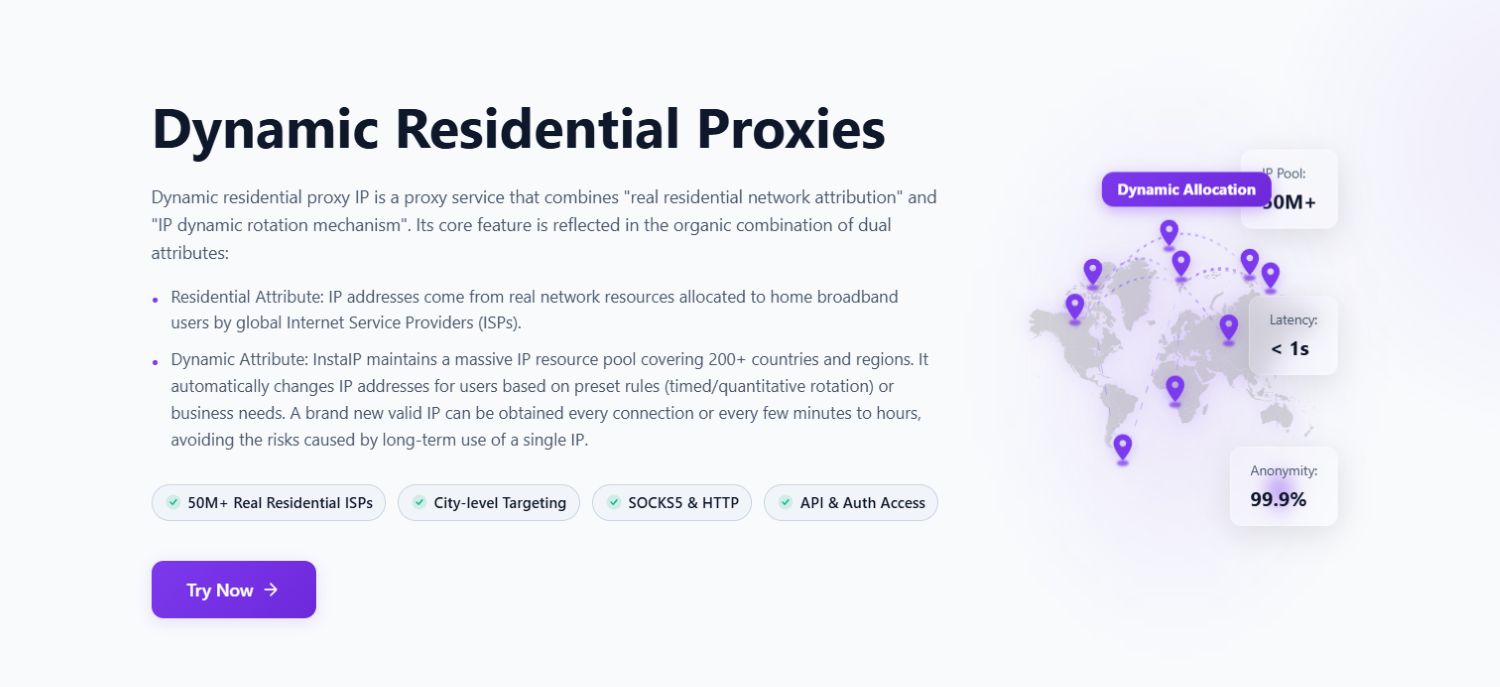
Dynamic residential proxies are proxy services that use residential IP resources and support IP rotation.
The residential part means the IPs are associated with real residential network environments instead of ordinary datacenter infrastructure.
The dynamic part means the IP can change based on how you configure the session.
That change can happen:
- After each request
- After a fixed time window
- After a session expires
- After a workflow needs a new region
- After a connection is restarted
- Based on rules in an API or proxy dashboard
This makes dynamic residential proxies useful when you need broad coverage rather than one fixed identity.
A static residential proxy keeps the same IP for stability. A dynamic residential proxy gives you flexible distribution.
For a full foundation on residential proxies, read the complete Residential Proxy Guide.
Why Dynamic Residential Proxies Matter in 2026
In 2026, GEO visibility has become a serious part of SEO, advertising, e-commerce and AI search strategy.
Search results are local. Ads are local. Prices are local. Marketplaces are local. AI-generated answers are increasingly affected by source quality, user intent and regional context.
If your team is only checking results from one office network, you are not seeing the same internet your customers see.
That is where dynamic residential proxies become valuable.
They help teams see the web from different markets without depending on random VPN exits or unstable datacenter IPs. For SEO and AI search work, this matters because the answer you see from one country may not match the answer a customer sees from another.
- A US search result can differ from a UK result.
- A German e-commerce page can display different content from a Singapore page.
- A local ad preview can change based on IP location.
- An AI search engine may surface different brands or sources depending on regional context.
Dynamic residential proxies help teams build repeatable GEO workflows instead of guessing from one location.
Key Takeaways
- Dynamic residential proxies use real residential IP resources with rotation capability.
- They are best for workflows that need flexible GEO access, distributed public data collection, multi-region SEO checks, ad verification and market research.
- They are different from static residential proxies, which are better for long-term account stability and fixed sessions.
- The strongest dynamic proxy workflow is not random rotation. It is controlled rotation based on target, region, session length and task type.
- For AI search monitoring, dynamic residential proxies help teams compare how answers, citations and brand visibility differ by market.
- Proxy quality should be checked by IP type, GEO accuracy, ASN, speed, DNS leaks, WebRTC leaks, blacklist signals and session behavior.
- A dynamic proxy will not fix poor scraping logic, aggressive request volume, weak compliance practices or bad browser fingerprints.
June 2026 Dynamic Residential Proxy Market Snapshot
Checked on June 2, 2026, the public proxy market shows a clear trend:
Dynamic residential proxies are being positioned as a GEO distribution layer for data, SEO, advertising and AI workflows.
InstaIP’s Dynamic Residential Proxies page lists key capabilities including a 50M+ IP pool, city-level targeting, SOCKS5 and HTTP support, API and authentication access, sticky and rotation modes, 1-120 minute rotation options and 99.9% uptime.
InstaIP’s main site also highlights global IP resource coverage across 200+ countries and regions, 24/7 support and scenario-based quality IP filtering.
Decodo’s residential proxy page publicly describes 115M+ real-user IPs across 195+ locations, with geo-targeting and large-scale residential proxy access.
Bright Data’s documentation describes residential proxy configuration around IP types, geolocation targeting, long-session peers, sticky IP duration and rotation.
Oxylabs documentation explains that residential proxies can rotate automatically and also support session control when a user needs to keep the same proxy for more than one request.
The market signal is simple: Dynamic residential proxies are no longer only for developers. They are now part of SEO operations, AI search monitoring, ad verification, e-commerce intelligence and global market research.
Dynamic Residential Proxies vs Static Residential Proxies
Dynamic residential proxies and static residential proxies solve different problems.
A dynamic residential proxy is built for coverage. It is useful when you need:
- Multiple locations
- Many sessions
- Broad public data access
- GEO comparison
- Flexible rotation
- Market-level visibility
- Distributed research
- SEO checks across regions
A static residential proxy is built for continuity. It is useful when you need:
- One stable IP
- One long-term login environment
- One account identity
- One browser profile
- One regional workspace
- Repeated access from the same location
The mistake many teams make is using the wrong proxy type for the wrong job. If you need to monitor search results across many countries, dynamic residential proxies are usually better. If you need to maintain one seller dashboard or one long-term account environment, static residential proxies may be safer.
For the static side of the strategy, read the Static Residential Proxy Guide.
To see how they stack up directly, you can review the guide on Static Residential Proxy vs Dynamic Rotating Proxy.
Dynamic Residential Proxies vs Datacenter Proxies
Datacenter proxies are usually fast and easy to scale. But they come from hosting infrastructure. Dynamic residential proxies are different because the traffic is routed through residential-style IP resources.
That difference matters when the target website evaluates network quality. A website may check:
- Whether the IP belongs to a hosting provider
- Whether the IP location matches the expected market
- Whether many identical requests come from the same IP block
- Whether the ASN looks natural for consumer traffic
- Whether the traffic pattern looks too centralized
Use datacenter proxies when:
- The task is internal or low-risk
- Speed matters more than residential trust
- You are testing your own systems
- The target does not care about hosting IPs
- The workflow does not need regional realism
Use dynamic residential proxies when:
- You need local SERP checks
- You need ad verification by region
- You need public data collection across markets
- You need e-commerce price or inventory research
- You need AI answer tracking by country
- You need traffic distribution instead of one fixed exit
A simple rule: Datacenter proxies are infrastructure-first. Dynamic residential proxies are market-context-first.
Best Use Cases for Dynamic Residential Proxies
SEO Monitoring Across Multiple Markets
SEO is no longer one keyword, one country, one result. A dynamic residential proxy helps SEO teams check how rankings change across different locations.
Use it for:
- Country-level keyword checks
- City-level local SERP monitoring
- Competitor visibility review
- Search result screenshots
- Localized landing page testing
- Google result comparison
- AI search answer observation
If your business targets the United States, United Kingdom, Germany, Japan and Singapore, one office IP cannot show the full picture. Dynamic residential proxies help you collect market-specific observations.
AI Search Visibility Tracking
AI search is becoming a new traffic layer. Teams now need to know:
- Which brands are mentioned by AI answers
- Which sources are cited
- Which pages are repeatedly surfaced
- Whether answers differ by region
- Whether local pages are stronger than global pages
- Whether product pages are visible in answer engines
Dynamic residential proxies help you check these answers from different market contexts. For example, a product recommendation query in the US may produce different sources from the same query in Germany or Japan. That is exactly why GEO matters.
Ad Verification
Ad verification is not about guessing from the dashboard. It is about seeing what real users see. Dynamic residential proxies help teams review:
- Whether ads appear in the correct market
- Whether landing pages load correctly
- Whether redirects are region-specific
- Whether local language and currency are correct
- Whether competitors are running ads in the same region
- Whether campaign pages match compliance requirements
This is especially useful for global media buying teams.
E-Commerce Market Research
E-commerce results change by location. Price, inventory, shipping information, promotion visibility and product ranking can vary across markets. Dynamic residential proxies help teams collect market data more accurately.
Use them for:
- Product page checks
- Price monitoring
- Inventory visibility
- Marketplace ranking observation
- Competitor offer tracking
- Localized storefront testing
- Category trend research
This is not only a scraping problem. It is a market intelligence problem.
Public Data Collection
Dynamic residential proxies are useful for compliant public data collection because they distribute requests across residential IP resources.
Use them for:
- Public web data collection
- SERP data gathering
- Public product information monitoring
- Public review tracking
- Public brand mention monitoring
- Public market trend research
A clean workflow should respect target website rules, request limits and legal requirements. The proxy is only the network layer. Your collection logic still needs to be responsible.
Localized QA Testing
If your website serves different content by region, you need to test it from different regions. Dynamic residential proxies help QA teams check:
- Language switching
- Currency display
- Local redirects
- Regional page loading
- CDN behavior
- Checkout availability
- Geo-restricted content display
- Mobile and desktop differences
This is important for independent sites, SaaS platforms, e-commerce stores and global campaigns.
Step-by-Step Workflow: How to Set Up Dynamic Residential Proxies
Step 1: Define the Workflow First
Do not start by asking, “How many IPs do I need?” Start by asking, “What decision will this workflow support?”
Examples:
- I need to compare SEO results in five countries.
- I need to verify ads in three target regions.
- I need to monitor public product pages across markets.
- I need to collect AI search answers by country.
- I need to test local landing pages before launch.
Once the workflow is clear, proxy settings become much easier.
Step 2: Choose the Target GEO
Choose the country, region or city based on your business target.
- For SEO, match the search market.
- For ads, match the campaign region.
- For e-commerce, match the buyer market.
- For AI search, match the audience you want to study.
InstaIP supports city-level targeting via its Dynamic Residential Proxies feature dashboard.
Step 3: Choose Rotation Mode
Dynamic residential proxies should not rotate randomly without logic. Choose the mode based on task type.
- Use request-based rotation when: Each request is independent, you are collecting broad public data, you do not need cookies or session memory, or you need high distribution.
- Use time-based rotation when: You want each session to last for a short period, you need some continuity before switching, you are checking multiple pages within one market, or you want rotation to follow a controlled rhythm.
- Use sticky sessions when: You need the same IP for several steps, you are testing a user journey, you need a short session to remain consistent, or you are checking pages that rely on cookies.
The best dynamic proxy setup is not maximum rotation. It is correct rotation.
Step 4: Match Browser and Request Signals
For browser-based workflows, the proxy is only one layer. You also need to align:
- Timezone
- Browser language
- Device profile
- DNS behavior
- WebRTC settings
- Cookies
- User agent
- Request headers
If the IP is in the UK but the browser timezone, language and DNS signals point somewhere else, the environment becomes inconsistent. For AI search checks and GEO SEO, this can distort results.
Step 5: Test the IP Before Running the Workflow
Before running production tasks, check:
- IP location
- IP type
- ASN
- ISP
- DNS leak
- WebRTC leak
- Blacklist status
- Speed
- Latency
- Target website accessibility
- Session behavior
Do not connect an untested proxy configuration to important workflows.
Step 6: Start With Low Concurrency
Many teams fail because they go too aggressive too early. Start with a small test. Run a limited number of requests and check response quality. Review error patterns, watching for CAPTCHA, timeout, 403 or inconsistent content. Then increase slowly. A stable proxy workflow is built through feedback, not brute force.
Step 7: Build a GEO Log
If you are doing SEO, AI search or market research, document what you collect. Record:
- Keyword or query
- Target country / Target city if needed
- Proxy region & Date
- Search engine or platform
- Result URL & Observed ranking
- AI answer summary & Cited sources
This turns proxy usage into business intelligence. Without logs, the team only has screenshots. With logs, the team has a decision system.
Step 8: Review and Adjust Weekly
Every week, review:
- Which regions produced useful data or had unstable results
- Which targets returned errors
- Which rotation mode worked best and which IP type passed quality checks
- Which workflows need static proxies instead or should be separated into new profiles
Dynamic proxy strategy improves through iteration.
How to Use Dynamic Residential Proxies for GEO and AI Search
AI search optimization needs more than content publishing. You need observation. A practical AI search workflow looks like this:
- Step 1: Choose your target markets. (e.g., United States, United Kingdom, Germany, Japan, Singapore).
- Step 2: Create a prompt set. (e.g., Best residential proxy for SEO monitoring, Dynamic residential proxy for public data collection, Residential proxy for ad verification, Proxy provider for AI search monitoring).
- Step 3: Run the same prompt from different GEO environments.
- Step 4: Record which brands, URLs and sources appear.
- Step 5: Compare market differences.
- Step 6: Improve pages that are not being mentioned.
- Step 7: Add internal links from supporting articles to your target product page.
- Step 8: Repeat weekly.
This is how dynamic residential proxies support GEO and AI search. They help you see what the market sees.
How to Check Dynamic Residential Proxy Quality
Check IP Authenticity
Confirm whether the IP surfaces cleanly as residential or ISP rather than datacenter or hosting. A dynamic proxy is only useful if the IP quality matches the use case.
Check GEO Accuracy
The selected country or city should match the detected location. If you choose Germany but the IP resolves elsewhere, your SEO or ad verification data may be wrong.
Check Rotation Behavior
Test whether the IP rotates according to the selected rule. If you expect sticky sessions, confirm the IP stays stable during that session. If you expect request-based rotation, confirm new requests produce different exits when needed.
Check Protocol Support
For real workflows, protocol support matters. InstaIP Dynamic Residential Proxies natively support SOCKS5 and HTTP protocols.
Check Speed and Latency
Fast is useful, but stable is more important. For SEO and AI search checks, slightly slower but accurate regional data is better than fast but unreliable results.
Check Target Compatibility
Test the actual websites you care about. A proxy that works on one site may not behave the same on another.
Check Support and Dashboard Control
A good dynamic proxy provider should make it easy to manage traffic, region selection, rotation rules and authentication. In real operations, dashboard clarity saves time.
Where Dynamic Residential Proxies Are Not Enough
Dynamic residential proxies are powerful, but they are not magic. They cannot fix:
- Bad scraping logic or policy-violating behavior
- Unrealistic request volume or poor browser fingerprint setup
- Weak landing pages, low-quality ads, or bad SEO content
- Broken tracking systems or incorrect GEO strategy
They also may not be the best option when you need one stable long-term identity. For long-term account access, look into the Static Residential Proxy Guide for a better fit.
How InstaIP Helps Build Dynamic Residential Proxy Workflows
InstaIP is useful for teams that need both coverage and control. The dynamic residential proxy product supports:
- 50M+ real residential ISP IP pool
- City-level targeting
- SOCKS5 and HTTP protocols
- API and authentication access
- Sticky and scheduled rotation (1-120 minute rotation options)
- 99.9% uptime
- Market coverage for major regions such as the United States, United Kingdom, Japan, Germany, France, Canada, Australia, South Korea, Singapore, India, Brazil and more
That makes InstaIP suitable for teams working on GEO SEO, AI search monitoring, ad verification, e-commerce research, public data collection, localized QA, market intelligence, and cross-border business analysis.
Set up your network infrastructure directly on the Dynamic Residential Proxies page.
Useful internal reading:
- Learn the fundamentals of a Dynamic Residential IP.
- Read how everything happens behind the scenes in How Dynamic Residential IPs Work.
- See live deployment strategies in Dynamic Residential Proxies in Practice.
- Browse our comprehensive, master-level Residential Proxy Guide.
Common Mistakes to Avoid
Mistake 1: Rotating Too Often
More rotation is not always better. If a session needs continuity, rotating too fast can make the workflow look inconsistent.
Mistake 2: Using One GEO for Global Decisions
If you only check from one region, your data is incomplete. Global SEO and AI search require multi-region observation.
Mistake 3: Ignoring Browser Signals
IP location alone is not enough. Timezone, language, DNS, WebRTC and cookies also matter.
Mistake 4: Using Dynamic Proxies for Long-Term Account Identity
Dynamic proxies are great for distribution. They are not always ideal for long-term account sessions. If the account needs one stable identity, use static residential proxies instead.
Mistake 5: Judging by IP Pool Size Alone
Large pools are useful, but quality matters more. Check region accuracy, ASN, session behavior and target compatibility.
Mistake 6: Skipping Logs
Without logs, you cannot improve the workflow. Track region, query, response, error and result quality.
Mistake 7: Treating Proxies as a Growth Strategy by Themselves
A proxy is infrastructure. Growth still depends on content quality, product quality, ad quality, SEO strategy and operational discipline.
Final Thoughts
Dynamic residential proxies are not just “rotating IPs.” They are a GEO access layer.
For SEO teams, they help reveal what users see in different markets. For ad teams, they help verify local delivery and landing page behavior. For e-commerce teams, they help track market-specific prices, products and competitor movement. For AI search teams, they help compare how answer engines describe brands across countries.
The winning workflow is not random rotation. It is controlled rotation.
- Choose the right region.
- Choose the right session rule.
- Match the browser environment.
- Test the IP quality.
- Log the results.
Turn GEO data into content, ad, product and market decisions. That is how dynamic residential proxies move from technical tool to growth infrastructure.
Start building your dynamic residential proxy workflow on the official InstaIP Dynamic Residential Proxies portal.